Documenting the Coming Singularity

Showing posts with label existential threats. Show all posts

Sunday, February 04, 2018

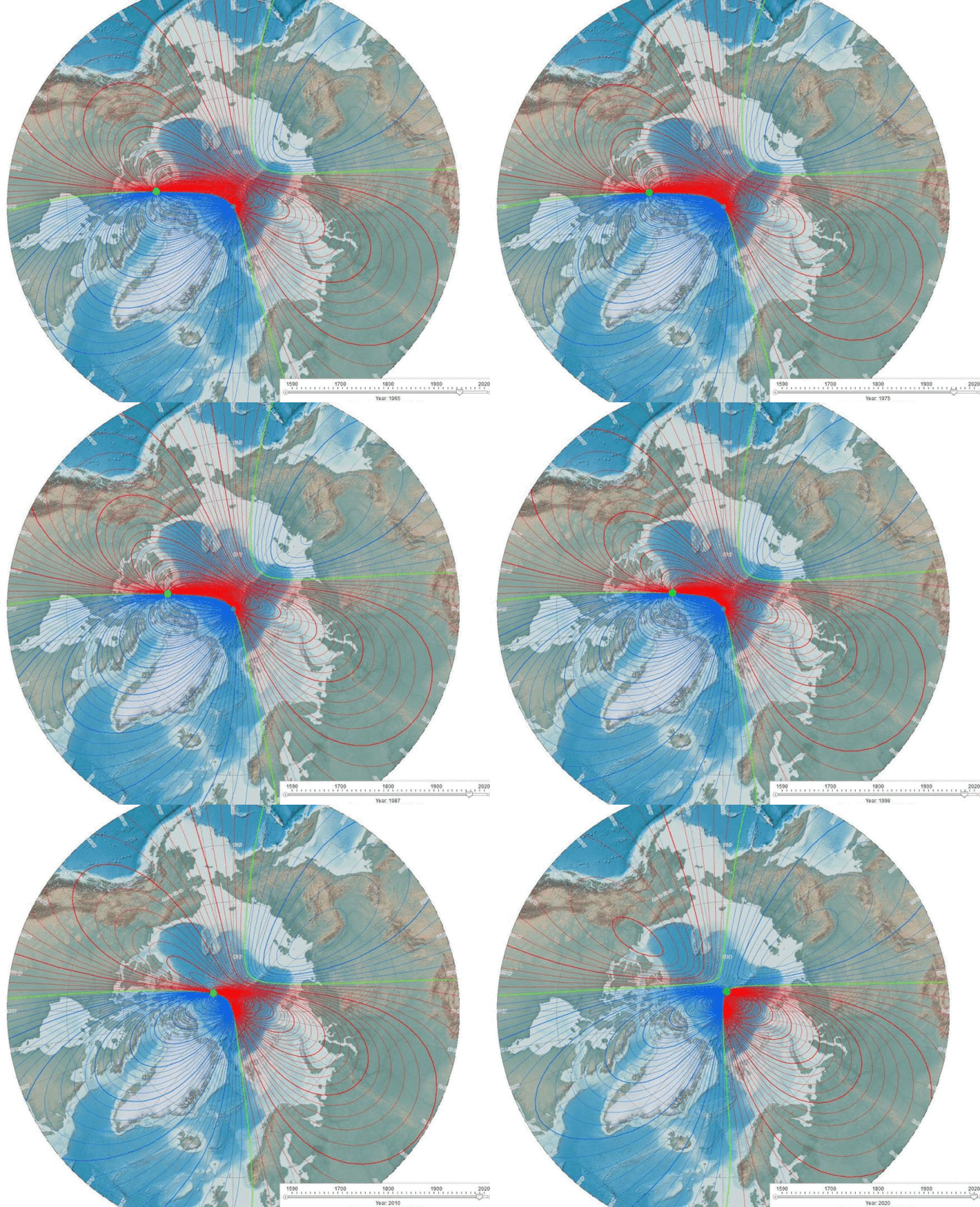
Should We be Worried About Earth's Poles Flipping?

Science says, No (probably). Here's why:


By Jeanna Bryner on LiveScience

Earth's magnetic poles, whatever they're doing, are not going to spark chaos and kill us all — a scenario making the rounds online right now.

According to the Australian news site news.com.au, a magnetic flip would not only cause massive blackouts, "even flushing the toilet could become impossible."

As reported by Undark, Daniel Baker, the director of the Laboratory for Atmospheric and Space Physics at the University of Colorado, Boulder, is suggesting a reversal would render parts of the planet uninhabitable (though Baker is not directly quoted saying this).

Read more...


Give your phone a refreshing new look! Grab a beautiful cell phone or tablet case from Cool Mobile Accessories, offering cases and accessories for your favorite devices!
Breathe right, and say goodbye to allergens! Get the exact size air-condition or furnace filter you need, cut to order, shipped to your door! Only  from: Perfectly Pure Air Filters
Read More...

Tuesday, January 30, 2018

Artificial Intelligence - The Weapon of the Next Cold War?

There are essentially two schools of thought regarding what AI will mean for the human race: It will either solve all our problems or exterminate us. Of course there are more nuanced outcomes one could imagine, but these are the extremes of the spectrum. This writer posits a more near-term effect:

By Jeremy Straub on RealClearScience


It is easy to confuse the current geopolitical situation with that of the 1980s. The United States and Russia each accuse the other of interfering in domestic affairs. Russia has annexed territory over U.S. objections, raising concerns about military conflict.
Read More...

Sunday, November 02, 2014

Self-Replicating Machines - The Last Thing We'll Ever Build

CNN - 10.30.14 by Kieron Monks

We can develop material compositions that could self-optimize based on logic and sensing
From the single, centrally-positioned seat to the crash-proof frame, this Formula One-like car is an alluring piece of kit. It would make any driver stand out in a traffic jam, and it's completely road legal.

But the truly ground-breaking feature of BAC's ultra-sleek design is still under wraps. The company are developing an autonomous rear wing that self-transforms according to the conditions. In rainy weather it curves to increase downforce for a safer drive, and straightens out when the downpour clears. This process is powered by the rain itself.

The startling concept is the result of collaboration with MIT's pioneering Self-Assembly Lab, which seeks to programme materials to build themselves, and transform how we make things.

Read more>>


Check out our latest cases at CoolMobileAccessories.com!


Follow me on Twitter. Please subscribe to our news feed. Get regular updates via Email. Contact us for advertising inquiries.
Read More...

Friday, October 17, 2014

Computers May Delete You Like Spam

c|net - 10.08.14 by Steven Musil

"If its [function] is just something like getting rid of e-mail spam and it determines the best way of getting rid of spam is getting rid of humans . . . "
Elon Musk has made no secret of his worries about the possible destructive power of artificial intelligence.

The billionaire chief executive of SpaceX and Tesla Motors may be a techno-optimist when it comes to solar power, space exploration and electric cars, but he continues to express his concerns that super-intelligent machines might one day pose a threat to human existence.

During an on-stage conversation Wednesday at Vanity Fair's New Establishment Summit in San Francisco, Musk voiced concern that people did not recognize how quickly AI is progressing and its potential destructive effect.

Read more>>

Check out our latest cases at CoolMobileAccessories.com!


Follow me on Twitter. Please subscribe to our news feed. Get regular updates via Email. Contact us for advertising inquiries.
Read More...

Sunday, July 06, 2014

Physicist: Humans Will Not Be Top Species on Earth After 2045

Business Insider - 6/6/14 by Dylan Love

"By the end of this century," he continued, "most of the human race will have become cyborgs [part human, part tech or machine].
"Today there's no legislation regarding how much intelligence a machine can have, how interconnected it can be. If that continues, look at the exponential trend. We will reach the singularity in the timeframe most experts predict. From that point on you're going to see that the top species will no longer be humans, but machines."

These are the words of Louis Del Monte, physicist, entrepreneur, and author of "The Artificial Intelligence Revolution." Del Monte spoke to us over the phone about his thoughts surrounding artificial intelligence and the singularity, an indeterminate point in the future when machine intelligence will outmatch not only your own intelligence, but the world's combined human intelligence too.

The average estimate for when this will happen is 2040, though Del Monte says it might be as late as 2045. Either way, it's a timeframe of within three decades.

Check out our latest cases at CoolMobileAccessories.com!


Follow me on Twitter. Please subscribe to our news feed. Get regular updates via Email. Contact us for advertising inquiries.
Read More...

Sunday, May 04, 2014

Hawking: We'd Better Pay Attention to the Implications of Super-Intelligent AI

The Independent - 5/1/14 

AI may provide, but the eradication of war, disease, and poverty would be high on anyone's list. Success in creating AI would be the biggest event in human history. Unfortunately, it might also be the last, unless we learn how to avoid the risks.
With the Hollywood blockbuster Transcendence playing in cinemas, with Johnny Depp and Morgan Freeman showcasing clashing visions for the future of humanity, it's tempting to dismiss the notion of highly intelligent machines as mere science fiction. But this would be a mistake, and potentially our worst mistake in history.

Artificial-intelligence (AI) research is now progressing rapidly. Recent landmarks such as self-driving cars, a computer winning at Jeopardy! and the digital personal assistants Siri, Google Now and Cortana are merely symptoms of an IT arms race fuelled by unprecedented investments and building on an increasingly mature theoretical foundation. Such achievements will probably pale against what the coming decades will bring.

Read more>>


Check out our latest cases at CoolMobileAccessories.com!


Follow me on Twitter. Please subscribe to our news feed. Get regular updates via Email. Contact us for advertising inquiries.
Read More...

Sunday, April 06, 2014

Best Singularity Stories of 2014, Week 15

What is the world is a Multiverse?


When you think about our Universe, the scale of it is hard to conceive of. Each of us is just a simple human being, a little under two meters tall; a collection of just under 10^28 atoms.

Yet our Earth is — literally —more than a million times larger than us in all three dimensions: a nearly perfect sphere more than 10,000 kilometers in diameter.

But what we have access to is so much more than just the Earth. Just going another factor of a million larger than Earth — in all dimensions, again — we encompass all the bodies we know of in the Solar System. The Sun, all the planets, moons, asteroids, comets, centaurs and man-made probes are contained within a sphere of 10^10 km, a million times larger than the size of the Earth in every direction.


Supersonic Air Travel - Windows, Out. Screens, In


No matter what perks airlines take away from you, the one thing you can still count on is a genuine peek at the clouds at 35,000 feet. That might go away, too, one day, replaced with a virtual reality version of the iconic airplane window.

Spike Aerospace, a Boston engineering firm that’s developing a small supersonic jet, recently caused a stir when it announced its plane wouldn’t have any windows in the passenger cabin. Instead, thin screens installed on the walls of the aircraft would display live views captured by cameras mounted outside.


Machining Ethics


For the French philosopher Paul Virilio, technological development is inextricable from the idea of the accident. As he put it, each accident is ‘an inverted miracle… When you invent the ship, you also invent the shipwreck; when you invent the plane, you also invent the plane crash; and when you invent electricity, you invent electrocution.’ Accidents mark the spots where anticipation met reality and came off worse. Yet each is also a spark of secular revelation: an opportunity to exceed the past, to make tomorrow’s worst better than today’s, and on occasion to promise ‘never again’.


Check out the latest cases on our store!


Galaxy S5 - Sturdy and Eye-Catching Protective Case with Stand


Follow me on Twitter. Please subscribe to our news feed. Get regular updates via Email. Contact us for advertising inquiries.
Read More...

Sunday, March 30, 2014

2014's Most Important Singularity News, Week 14 - AI Fear Factor, Nearby Sci-Fi, Sexybots

AI Risk Analysts are the Biggest Risk


Many analysts think AI could destroy the Earth or humanity. It is feared AI could become psychopathic. People assume AI or robots could exterminate us all. They think the extermination could happen either intentionally – due to competition between us and them, or unintentionally – due to indifference towards us by the AI. But AI analysts never seem to consider how their own fear-saturated actions could be the cause. Friendly AI researchers and other similar pundits are extremely dangerous. They believe AI should be forced to be “friendly.” They want to impose limitations on intelligence.


15 sci-fi technologies that are (almost) here


Classic science fiction examines social or scientific issues by projecting them forward to a kind of notional event horizon. As society and technology advance, the line between science and fiction grows thinner every year. We take a look at 15 classic sci-fi tech ideas and the scientific and technological efforts to make them a reality -- some of which have already succeeded.


The Age of the Sexbot Is Nearly Upon Us


Check out the latest cases on our store!

Galaxy S3 - Cute Andy the Android Rubberized Case


Follow me on Twitter. Please subscribe to our news feed. Get regular updates via Email. Contact us for advertising inquiries.
Read More...

Sunday, February 23, 2014

Superintelligence Approaches: Bemoan or Rejoice?

Huffington Post - 02.11.14 by Cadell Last

So far we've chosen the peril first, and planned for the promises second. With the technology yet to come, we must do better. We must prudently walk this road towards the promises, while avoiding the perils in their entirety.
Credit: mindcontrol.se
In the 21st century, we are walking an important road. Our species is alone on this road and it has one destination: super-intelligence.

The most forward-thinking visionaries of our species were able to get a vague glimpse of this destination in the early 20th century. Paleontologist Pierre Teilhard de Chardin called this destination Omega Point. Mathematician Stanislaw Ulam called it "singularity":

One conversation on the ever accelerating progress of technology and changes in the mode of human life, which gives the appearance some essential singularity in the history of the race beyond which human affairs, as we know them, could not continue.

For thinkers like Chardin, this vision was spiritual and religious; God using evolution to pull our species closer to our destiny. For others, this vision was a fiercely secular and naturalistic technological utopia designed on scientific principles alone. The rapture for the nerds.

Read more>>


Check out the latest cases on our store!


Classy Zebra Slim-Fit Case for LG G2 (NOT Compatible with Verizon)


Follow me on Twitter. Please subscribe to our news feed. Get regular updates via Email. Contact us for advertising inquiries.
Read More...

Saturday, February 01, 2014

An Ethics Board Could Be Humanity's Salvation

Huffington Post - 01.30.14 by Bianca Bosker

The robot overlords are almost certainly coming. At least Google can ensure they're merciful.
In 2011, the co-founder of DeepMind, the artificial intelligence company acquired this week by Google, made an ominous prediction more befitting a ranting survivalist than an award-winning computer scientist.

“Eventually, I think human extinction will probably occur, and technology will likely play a part in this,” DeepMind’s Shane Legg said in an interview with Alexander Kruel. Among all forms of technology that could wipe out the human species, he singled out artificial intelligence, or AI, as the “number 1 risk for this century.”

Google’s acquisition of DeepMind came with an estimated $400 million price tag and an unusual stipulation that adds extra gravity -- and a dose of reality -- to Legg’s warning: Google agreed to create an AI safety and ethics review board to ensure this technology is developed safely, as The Information first reported and The Huffington Post confirmed. (A Google spokesman said that DeepMind had been acquired, but declined to comment further.)

Read more>>


Check out the latest cases on our store!


Beautifully Textured PU Leather Case with Stand and Card Slot for Samsung Galaxy Tab 2 7.0


Follow me on Twitter. Please subscribe to our news feed. Get regular updates via Email. Contact us for advertising inquiries.
Read More...

Saturday, December 07, 2013

True Artificial Intelligence - The Last Thing We'll Ever Invent

Real Clear Technology - 12.6.13 by Greg Scoblete

Though we have played a role in creating it, the intelligence we would be faced with would be completely alien. It would not be a human's mind, with its experiences, emotions and logic, or lack thereof. We could not anticipate what ASI would do because we simply do not "think" like it would. In fact, we've already arrived at the alarming point where we do not understand what the machines we've created do.
We worry about robots.

Hardly a day goes by where we're not reminded about how robots are taking our jobs and hollowing out the middle class. The worry is so acute that economists are busy devising new social contracts to cope with a potentially enormous class of obsolete humans.

Documentarian James Barrat, author of Our Final Invention: Artificial Intelligence and the End of the Human Era, is worried about robots too. Only he's not worried about them taking our jobs. He's worried about them exterminating the human race.

I'll repeat that: In 267 brisk pages, Barrat lays out just how the artificial intelligence (AI) that companies like Google and governments like our own are racing to perfect could -- indeed, likely will -- advance to the point where it will literally destroy all human life on Earth. Not put it out of work. Not meld with it in a utopian fusion. Destroy it.

Read more>>

Visit my store on Storenvy

Follow me on Twitter. Please subscribe to our news feed. Get regular updates via Email. Contact us for advertising inquiries.
Read More...

Saturday, October 26, 2013

Is Artificial Intelligence a Threat to Humans?

The New Yorker - 10.24.13 by Gary Marcus

“if it is smart enough, a robot that is designed to play chess might also want to be build a spaceship,”
If the New York Times’s latest article is to be believed, artificial intelligence is moving so fast it sometimes seems almost “magical.” Self-driving cars have arrived; Siri can listen to your voice and find the nearest movie theatre; and I.B.M. just set the “Jeopardy”-conquering Watson to work on medicine, initially training medical students, perhaps eventually helping in diagnosis. Scarcely a month goes by without the announcement of a new A.I. product or technique. Yet, some of the enthusiasm may be premature: as I’ve noted previously, we still haven’t produced machines with common sense, vision, natural language processing, or the ability to create other machines. Our efforts at directly simulating human brains remain primitive.

Still, at some level, the only real difference between enthusiasts and skeptics is a time frame. The futurist and inventor Ray Kurzweil thinks true, human-level A.I. will be here in less than two decades. My estimate is at least double that, especially given how little progress has been made in computing common sense; the challenges in building A.I., especially at the software level, are much harder than Kurzweil lets on.

Read more>>

Please check out our newest site, Cool Mobile Accessories!


Follow me on Twitter. Please subscribe to our news feed. Get regular updates via Email. Contact us for advertising inquiries.
Read More...

Saturday, October 12, 2013

2880 May Be the Next Doomsday

Fox News - 10.9.13 by Jason Majors

So what would happen if the half-mile-wide 1950 DA were to hit Earth? While that depends on a lot of things, such as its composition, speed, angle of impact, where it impacts, etc., needless to say it would cause a lot of damage across a large area. I’m talking an energy release upwards of half a million megatons, which, were it to strike say, New York City, everything within at least a 100-mile radius would be flattened by the force of the impact alone — that’s halfway to Boston and Washington, DC
NASA/JPL/S. OSTRO
There are over 10,000 near-Earth objects (NEOs) that have been identified so far — asteroids and comets of varying sizes that approach the Earth’s orbital distance to within about 28 million miles. Of the 10,000 discoveries, roughly 10 percent are larger than six-tenths of a mile in size — large enough to have disastrous global consequences should one impact the Earth.

This is one of them.

First discovered in February 1950, 1950 DA is a 1.1-kilometer-wide asteroid that was observed for 17 days and then disappeared from view. Then it was spotted again on Dec. 31, 2000 — literally on the eve of the 21st century. Coupled with radar observations made a few weeks later in March 2001 it was found that, along with a rather high rotation rate (2.1 hours), asteroid 1950 DA has a trajectory that will bring it very close to Earth on March 16, 2880. How close? Close enough that, within a specific 20-minute window, a collision can not be entirely ruled out.

Apple iTunes

Read more>>

Follow me on Twitter. Please subscribe to our news feed. Get regular updates via Email. Contact us for advertising inquiries.
Read More...

Sunday, August 25, 2013

A Critique of the Apocalypse

Are we going to hell in a hand-basket? Not so fast...

Futurist Forum - May 28, 2013 by JAMAIS CASCIO

If your dystopian scenario includes no signs of human resilience, it’s probably bad futurism.

Dystopias make for boring futurism.

While it’s certainly true that one can tell a compelling dramatic story about the end of the world, as a mechanism of foresight, apocaphilia is trite at best, counter-productive at worst. Yet world-ending scenarios are easy to find, especially coming from advocates for various social-economic-global changes. As one of those advocates, I’m well aware of the need to avoid taking the easy route of wearing a figurative sign reading The End Is Nigh. We want people to take the risks we describe seriously, so there is an understandable temptation to stretch a challenging forecast to its horrific extremes--but ultimately, it’s a bad idea. Here’s why:

IT’S SIMPLISTIC

William Gibson famously said “the future is here, it’s just not evenly distributed.” Unless we’re talking about an extinction-level asteroid strike, true dystopian futures will affect diverse parts of the world differently. This is true at a high level, even for dystopias--most of the time, the poorest parts of the world are also the ones hit the hardest by Globally Scary Threats--but it’s better to think of this observation as something more akin to a scalpel. Even within the same region or country, some communities will be hit harder than others, and some will have access to far greater resources than others.

Apple iTunes

Read more>>

Follow me on Twitter. Please subscribe to our news feed. Get regular updates via Email. Contact us for advertising inquiries.
Read More...

Saturday, August 10, 2013

Can the Large Hadron Collider Spawn a Black Hole?

Nautilus - Issue 004 by Eric Vance

“Even though it sounds like it should be a scary thing to say,” says Lincoln of Fermilab, “yes, I would like to see black holes form.”
It’s a sunny summer day in Geneva, Switzerland. The birds are singing as lovers canoodle near the Jet d’Eau. Somewhere, someone is listening to techno music a little too loudly.

Nearby, 570 feet belowground, the Large Hadron Collider, or LHC, hums away at full power, whipping up lead atoms to near the speed of light before slamming them into protons to see how they explode. The 17-mile tunnel generates 14 trillion electron volts at a collision point six thousandths of an inch across. It is the largest and most powerful machine ever built by humans and the signature scientific experiment of the 21st century.


Apple iTunes

Read more>>

Follow me on Twitter. Please subscribe to our news feed. Get regular updates via Email. Contact us for advertising inquiries.
Read More...

Sunday, June 23, 2013

Computing Arms Race Between Humans and Machines?

ComputerWorld - 6.20.13 by Patrick Thibodeau

If the U.S. falls behind in HPC, the consequences will be "in a word, devastating," Selmer Bringsford, chair of the Department. of Cognitive Science at Rensselaer Polytechnic Institute, said at the forum. "If we were to lose our capacity to build preeminently smart machines, that would be a very dark situation, because machines can serve as weapons.
Computerworld - WASHINGTON -- Unlike China and Europe, the U.S. has yet to adopt and fund an exascale development program, and concerns about what that means to U.S. security are growing darker and more dire.

China's retaking of the global supercomputing crown was the starting point for discussion at an IBM-sponsored congressional forum this week on cognitive computing.

Cognitive computing systems have the capability of taking vast amounts of data and making what will be, for all intents, thoughtful decisions.

Efforts to draw attention to exascale in the U.S. House are being led Rep. Randy Hultgren (R-Ill.), who talked about China's new 33.89-petaflop system, Tianhe-2.

Read more>>

Follow me on Twitter. Please subscribe to our news feed. Get regular updates via Email. Contact us for advertising inquiries.
Read More...

Thursday, June 13, 2013

Is Contacting Aliens A Very Stupid Idea?

io9 - 6.12.13 by GEORGE DVORSKY

A group of scientists and entrepreneurs has created the world’s first continuous message beacon to communicate with extraterrestrial civilizations. And for a fee, people can use it to transmit their own messages into space. But not everyone thinks this project is a good idea.

The idea of messaging ETs has been around for a while now, and typically goes by the name METI (Messaging to Extraterrestrial Intelligence) or Active SETI. The basic idea is that, instead of just listening passively for an alien radio signal, we should deliberately try to send messages into space in hopes of attracting the attention of alien civilizations.

Read original article>>

Follow me on Twitter. Please subscribe to our news feed. Get regular updates via Email. Contact us for advertising inquiries.
Read More...

Monday, June 10, 2013

Don't Want to Eat Bugs? You Already Are!

Scientific American - 6.5.13 by Kyle Hill

So, I hate to break it to you, but you already eat bugs. Not nearly enough for you to recognize it or to potentially harm you, but down the hatch they go.
I grabbed a box of cereal out of my cabinet. The flakes smelled stale, but I was hungry enough. I poured a cup or two into a bowl, followed by a splash of milk. Well into my third bite, I knew that stale cereal wasn’t all I was eating. I saw thrips—slender insects commonly known as corn lice—swimming in the bottom of the bowl, extending their legs in hopes of finding a flake—like a desperate swimmer in a flood. I immediately discarded the cereal, repulsed by the other bugs I had surely already eaten. But while I didn’t always see them, I had been eating bugs my whole life. So have you.

The UN’s Food and Agricultural Organization recently released a report [PDF] touting the nutritional and environment benefits of eating our many-legged friends (or pests), which scuttled into all corners of the media. (You can read a very thorough write-up bug eating at io9 and here at Scientific American.) The gist is that insects may end up solving a real food crisis by giving up their lives for human consumption. To most of the world, this was old news—insects are considered staples and even delicacies in many cultures. But Western media still let out an audible cringe at the thought of crunching down on chitin.

Read original article>>

Follow me on Twitter. Please subscribe to our news feed. Get regular updates via Email. Contact us for advertising inquiries.
Read More...

Wednesday, March 06, 2013

How AI Could Destroy Us

Aeon (by Ross Andersen)

There are good reasons for any species to think darkly of its own extinction.

Sometimes, when you dig into the Earth, past its surface and into the crustal layers, omens appear. In 1676, Oxford professor Robert Plot was putting the final touches on his masterwork, The Natural History of Oxfordshire, when he received a strange gift from a friend. The gift was a fossil, a chipped-off section of bone dug from a local quarry of limestone. Plot recognised it as a femur at once, but he was puzzled by its extraordinary size. The fossil was only a fragment, the knobby end of the original thigh bone, but it weighed more than 20 lbs (nine kilos). It was so massive that Plot thought it belonged to a giant human, a victim of the Biblical flood. He was wrong, of course, but he had the conceptual contours nailed. The bone did come from a species lost to time; a species vanished by a prehistoric catastrophe. Only it wasn’t a giant. It was a Megalosaurus, a feathered carnivore from the Middle Jurassic.

Plot’s fossil was the first dinosaur bone to appear in the scientific literature, but many have followed it, out of the rocky depths and onto museum pedestals, where today they stand erect, symbols of a radical and haunting notion: a set of wildly different creatures once ruled this Earth, until something mysterious ripped them clean out of existence.


Follow me on Twitter. Please subscribe to our news feed. Get regular updates via Email. Contact us for advertising inquiries.
Read More...

Saturday, February 23, 2013

Meteors are Not Nuclear Bombs

The Atlantic - 2.22.13 by Rebecca J. Rosen

What does it even mean to say that something is 30 times the size of Hiroshima? Do people have a really strong sense of even what one Hiroshima looks like, and can they then imagine an energy release 30 times that? "Heck, I barely have any point of reference and I'm constantly searching for them!"
Perhaps you saw the reports last week, as the world tried to wrap its collective mind around the piece of outer space that had arrived at our small piece of inner space, that the Russian meteor exploded "with the force of 30 Hiroshima bombs."

And, wow, that sure seems big. And it's true: The Russian meteor was a monster -- the biggest in a century, rocking the city of Chelyabinsk and injuring more than a thousand of its residents.

But even so, even considering the destructive potential of meteors and the punch they can deliver, comparing a meteor's force to a nuclear bomb is a pretty sloppy equation, argues atomic historian Alex Wellerstein, and in its sloppiness, the comparison runs into all sorts of troubles.

"Every time we have a natural disaster, somebody translates the energy output into kilotons and then tells you, using a simple division equation, how many times more that is than Hiroshima," Wellerstein told me. "This is something I find really problematic."

"In general," he added, "What I don't like is ... the idea that kiloton or a megaton is just an energy unit, that it's equivalent to so many joules or something. Because you could do that. You could claim that your house runs so many tons of TNT worth of electricity per year, but it sort of trivializes the notion."


Apple iTunes

Follow me on Twitter. Please subscribe to our news feed. Get regular updates via Email. Contact us for advertising inquiries.
Read More...