Documenting the Coming Singularity

Showing posts with label cultural shift. Show all posts

Wednesday, January 01, 2014

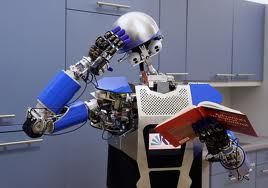
Are Robots About to Terminate Your Job?

Financial Times - 12.27.13 by Tim Harford

By the time today’s 10-year-olds have their degrees, computers could be a hundred times cheaper and smarter than they are today.
In future, there may be people who – despite being fit to work – have no economic value.

On August 29 1997, Skynet – a computer system controlling the US nuclear arsenal – became self-aware. Panicking operators tried to deactivate it. Skynet, perceiving the threat, launched its arsenal, killed most of humanity, and ushered in a world in which the robots ruled. So went the backstory of the 1984 movie The Terminator . But computers did not become self-aware in 1997 – the closest they managed was when Deep Blue, a B-list supercomputer, beat Garry Kasparov, the world chess champion. Despite decades of hand-wringing about robots taking over, the robots never quite seem to rise.

But perhaps 2014 will be different. Google certainly seems to think so: early in December it purchased Boston Dynamics, a producer of military prototype robots – with names such as “BigDog”, “WildCat” or “Petman” – that wouldn’t look out of place in the Terminator films. These nightmarish machines will now be brought to you by the folks who host all your email, know what your internet searches are and are tracking your phone’s location.


Visit my store on Storenvy

Follow me on Twitter. Please subscribe to our news feed. Get regular updates via Email. Contact us for advertising inquiries.
Read More...

Wednesday, November 27, 2013

Talk about drinking to forget!

Popular Science - 11.25.13 by Virginia Hughes

The idea of scientists manipulating memory does, naturally, sound a bit creepy. But it also points to some possible good: treatment for millions of people tormented by real memories. And that’s something worth remembering. 
Credit: Sam Kaplan
Roadside bombs, childhood abuse, car accidents—they form memories that can shape (and damage) us for a lifetime. Now, a handful of studies have shown that we’re on the verge of erasing and even rewriting memories. The hope is that this research will lead to medical treatments, especially for addiction and post-traumatic stress disorder (PTSD).

Researchers have known for decades that memories are unreliable. They’re particularly adjustable when actively recalled because at that point they’re pulled out of a stable molecular state. Last spring, scientists published a study performed at the University of Washington in which adult volunteers completed a survey about their eating and drinking habits before age 16. A week later, they were given personalized analyses of their answers that stated—falsely—that they had gotten sick from rum or vodka as a teen. One in five not only didn’t notice the lie, but also recalled false memories about it and rated that beverage as less desirable than they had before. Studies like these point to possible treatments for mental health problems. Both PTSD and addiction disorders hinge on memories that can trigger problematic behaviors, such as crippling fear caused by loud noises or cravings brought about by the sight of drug paraphernalia.

Read more>>


Follow me on Twitter. Please subscribe to our news feed. Get regular updates via Email. Contact us for advertising inquiries.
Read More...

Monday, September 02, 2013

The Bane of Our Time: How to Stop Oversharing on Facebook

Wired - 8.29.13 by Christina Bonnington

How searchable do you want to be? That is, who do you want to be able to look you up with your email address and phone number.
Photo: Ariel Zambelich/WIRED
Facebook wants you to share as much information about yourself as possible. It wants your friends to do the same. After all, the more personal details you feed into the network, the less likely you are to pack your data suitcase and leave. Advertisers tend to like all that data too. All this means your default privacy settings probably don’t jibe with how you want to actually share your information.

Luckily, you’re not defenseless. With a few small setting adjustments, you can take back control and make sure you share only what you want with the world.

One key thing to remember before we proceed though: The Internet is forever. Once you have posted something online, it does not belong to you anymore. If you’ve shared a photo or status update with anyone, it’s possible that they could screenshot it and share it with the world. So when in doubt, don’t post it.

Apple iTunes

Read more>>

Follow me on Twitter. Please subscribe to our news feed. Get regular updates via Email. Contact us for advertising inquiries.
Read More...

Saturday, August 24, 2013

How Netflix Changed Your Life

theguardian - 8.22.13 by Kevin Spacey

The warp speed of technological advancement – the internet, streaming, multi-platforming – happens to have coincided with the recognition of TV as an art form. So you have this incredible confluence of a medium coming into its own just as the technology for that medium is drastically shifting.
Photograph: Melinda Sue Gordon/AP
If there is anything about the character I play in House of Cards – Francis Underwood – that I suspect people admire it is that he has embraced a sense of total abandon. He has no allegiances to party, to titles, to forms, to labels: he doesn't care whether it's Democrats, Republicans, ideology or conviction. What he sees is opportunity and the chance to move forward. OK, he's a bit diabolical but he's also very effective.

It seems to me that, like Francis, audiences are no longer making distinctions between television and other media, so let's throw the labels out. Or, as Francis might say, "at least let's broaden the definitions – and if we have to call ourselves anything then aren't we all just storytellers?"

The success of the Netflix model – releasing the entire season of House of Cards at once and online – has proved one thing: the audience wants the control. They want freedom. If they want to binge then we should let them binge. And through this new form of distribution, I think we have demonstrated that we have learned the lesson the music industry didn't learn: give people what they want, when they want it, in the form they want it in – at a reasonable price – and they'll more likely pay for it rather than steal it. Well, some will still steal it, but I believe this new model can take a bite out of piracy.

Apple iTunes

Read more>>

Follow me on Twitter. Please subscribe to our news feed. Get regular updates via Email. Contact us for advertising inquiries.
Read More...

Sunday, August 11, 2013

Elysium is buildable

c|net - 8.9.13 by Eric Mack

The film starring Matt Damon and a really, really big space station hits theaters this weekend. Crave's Eric Mack speaks to one of the folks behind humanity's biggest space station about how far off a real-world "Elysium" might be.
This weekend, Matt Damon begins his run taking it to the 1 percenters on Elysium on behalf of the rest of us here on Earth -- a futuristic, poverty-ridden hellscape version of Earth, that is.

The film "Elysium" is the latest from "District 9" director Neill Blomkamp and opens Friday across the United States. If you haven't yet found yourself in the firing line of the barrage of promotional materials for the movie, the basic premise is that in the year 2154, humanity is divided between all the poor bastards stuck on an overpopulated, ruined Earth and the rich elite on a huge, halo-style space station where life resembles a stay at an all-inclusive resort.

If you're interested to see how Damon infiltrates Elysium and takes on the man to save his own hide, and perhaps the rest of the next century's 99 percenters, definitely check out the film. But I'm guessing that many Crave readers have already seen the trailers and are more interested in the technology in the film, particularly the giant Stanford Torus space station.

Apple iTunes

Read more>>

Follow me on Twitter. Please subscribe to our news feed. Get regular updates via Email. Contact us for advertising inquiries.
Read More...

Saturday, August 03, 2013

Trending - Solar Power and Net Metering

Digital Trends - By Bill Roberson  —   August 2, 2013

Under net metering, utility companies have to in some fashion pay the owners of private solar power installations (or other generators of renewable power, like wind farms they don’t own) for power generated beyond the needs of the solar/wind power facility owner, like that guy down the street that just had the big solar array put on his roof.
An interesting article published recently in the New York Times has me wondering if there isn’t a vast technological and industrial shift taking place in the United States – and maybe beyond – and how tech icon Elon Musk may be at the center of it, unintentionally or otherwise.

In a nutshell, the Times story essentially said that electrical utilities are waking up to the fact that residential solar installations are stealing their business. While they currently generate less than 1 percent of the power in the United States, their proliferation may pose a threat to the very existence of power-generating utilities in the long term.

Apple iTunes

Read more>>

Follow me on Twitter. Please subscribe to our news feed. Get regular updates via Email. Contact us for advertising inquiries.
Read More...

Monday, June 10, 2013

Don't Want to Eat Bugs? You Already Are!

Scientific American - 6.5.13 by Kyle Hill

So, I hate to break it to you, but you already eat bugs. Not nearly enough for you to recognize it or to potentially harm you, but down the hatch they go.
I grabbed a box of cereal out of my cabinet. The flakes smelled stale, but I was hungry enough. I poured a cup or two into a bowl, followed by a splash of milk. Well into my third bite, I knew that stale cereal wasn’t all I was eating. I saw thrips—slender insects commonly known as corn lice—swimming in the bottom of the bowl, extending their legs in hopes of finding a flake—like a desperate swimmer in a flood. I immediately discarded the cereal, repulsed by the other bugs I had surely already eaten. But while I didn’t always see them, I had been eating bugs my whole life. So have you.

The UN’s Food and Agricultural Organization recently released a report [PDF] touting the nutritional and environment benefits of eating our many-legged friends (or pests), which scuttled into all corners of the media. (You can read a very thorough write-up bug eating at io9 and here at Scientific American.) The gist is that insects may end up solving a real food crisis by giving up their lives for human consumption. To most of the world, this was old news—insects are considered staples and even delicacies in many cultures. But Western media still let out an audible cringe at the thought of crunching down on chitin.

Read original article>>

Follow me on Twitter. Please subscribe to our news feed. Get regular updates via Email. Contact us for advertising inquiries.
Read More...

Thursday, June 06, 2013

CIA Will Use Robot Writers

All Things D - 6.5.13 by Peter Kafka

If you’d like to see an example of their stuff, you can head to Forbes, which is using Narrative Science to create automated earnings reports and previews, like this look-ahead at Smucker’s prospects for tomorrow.
Narrative Science has already proven that its robot writers can make sentences that are good enough for newspapers and internal company reports. Now they’re going to work for the CIA.
The Chicago-based startup, which uses computers to turn structured data sets into prose, has raised an undisclosed amount of funding from In-Q-Tel, the venture firm that invests on behalf of the Central Intelligence Agency.* The money comes along with a deal to put Narrative Science’s automated writers to work for the CIA and “the broader intelligence community.”

Narrative Science had previously raised $6 million. While it made its initial splash by figuring out how to create sports stories based on box scores, without the need for human intervention, it has been making most of its money creating prose most people won’t ever see: Daily reports for the likes of financial services firms, or a large fast-food chain, etc. But I still think the notion of automated stories for newspapers and other publishers is both fascinating and unsettling, so I like to keep in touch with the company, even as it focuses on enterprise sales.

Read original article>>

Follow me on Twitter. Please subscribe to our news feed. Get regular updates via Email. Contact us for advertising inquiries.
Read More...

Saturday, June 01, 2013

Creating Sleep-Free Soldiers

Slate - 5.29.13 by William Saletan

There’s a military arms race to build soldiers who fight without fatigue.
Illustration by Robet Neubecker
All over the world, scientists are experimenting on soldiers to keep them awake beyond the limits of normal endurance. Researchers are engineering, and militaries are deploying, chemically enhanced troops. Of all the superpowers we’ve imagined, the one that has turned out to be most attainable—so attainable we’re already using it—is the ability to go without sleep.

Much of this research, which focuses on a drug called modafinil, is openly sponsored and supervised by military agencies. The United States leads the pack, conducting experiments through its Air Force Research Laboratory, Army Aeromedical Research Laboratory, Army Medical Research and Materiel Command, Walter Reed Army Institute of Research, and Special Operations Command Biomedical Initiative Steering Committee. Other countries’ armed forces are studying the same drug: Defense Research and Development Canada, China’s Second Military Medical University, the Netherlands Ministry of Defense, South Korea’s Air Force Academy, Taiwan’s National Defense Medical Center, and the Bioengineering Laboratory of Singapore’s Defense Medical and Environmental Research Institute. India is investigating modafinil through its Institute of Aerospace Medicine and Defence Institute of Physiology and Allied Sciences. France’s research program includes its Ministry of Defense, Military Health Service Research Center, and Institute of Aerospace Medicine. Many of the supervising agencies sound Orwellian: Human Effectiveness Directorate, Fatigue Countermeasures Branch, Département des Facteurs Humain. This, mind you, is just the published research. God knows what’s going on in secret.

Read article>>

Follow me on Twitter. Please subscribe to our news feed. Get regular updates via Email. Contact us for advertising inquiries.
Read More...

Monday, May 13, 2013

What To Do When Your Boss is a Robot

Mother Jones - May/June 2013 by Kevin Drum

Smart machines probably won't kill us all—but they'll definitely take our jobs, and sooner than you think.
Illustrations by Roberto Parada
THIS IS A STORY ABOUT THE FUTURE. Not the unhappy future, the one where climate change turns the planet into a cinder or we all die in a global nuclear war. This is the happy version. It's the one where computers keep getting smarter and smarter, and clever engineers keep building better and better robots. By 2040, computers the size of a softball are as smart as human beings. Smarter, in fact. Plus they're computers: They never get tired, they're never ill-tempered, they never make mistakes, and they have instant access to all of human knowledge.

The result is paradise. Global warming is a problem of the past because computers have figured out how to generate limitless amounts of green energy and intelligent robots have tirelessly built the infrastructure to deliver it to our homes. No one needs to work anymore. Robots can do everything humans can do, and they do it uncomplainingly, 24 hours a day. Some things remain scarce—beachfront property in Malibu, original Rembrandts—but thanks to super-efficient use of natural resources and massive recycling, scarcity of ordinary consumer goods is a thing of the past. Our days are spent however we please, perhaps in study, perhaps playing video games. It's up to us.


Follow me on Twitter. Please subscribe to our news feed. Get regular updates via Email. Contact us for advertising inquiries.
Read More...

Saturday, March 02, 2013

Kiss Privacy Googbye - Google Glass Makes Privacy a Thing of the Past

techradar - 3.1.13 by Gary Marshall

Hurst's worst-case scenario - everything you ever say or do indexed and searchable, with Google Glass embedded into contact lenses so you've no idea who's using it - might be a long way off, but the fundamental problem he's identified is very real.

From time to time we have a mass privacy panic, usually because politicians propose doing something dumb. "How dare you spy on us very slightly!" we yell. "We demand our privacy!"

And then Google does something much worse and the only thing we seem to care about is whether we'll look stupid or not.

We yell the instant any government proposes monitoring our communications.

Why aren't people yelling about Google Glass?


Hotwire US

Follow me on Twitter. Please subscribe to our news feed. Get regular updates via Email. Contact us for advertising inquiries.
Read More...

Saturday, January 19, 2013

Facebook Friends... Off With Their Heads!

Gizmodo - 1.18.13 by Sam Biddle

It doesn't matter how many friends you have on Facebook. You have too many, whether it's 400 or 2,000.

You have too many friends—I promise you. Really. You've been collecting them for probably half a decade, like barnacles on the side of a slow boat, and they're holding you back. They're also threatening your privacy. End it.

You might have heard of Dunbar's Number, a psychological "law" that human beings can't maintain meaningful relationships with between 100 to 230 other people. Hahaha. Plenty of us have several hundreds, if not thousands of Facebook friends. The transformation of Facebook "friendship" into something abstract and laughable is well-trodden by now, and we've sort of started to just take it as a modern shrug. That's just the way things are now—the joy of rediscovering people from high school has been replaced with the endless chore of clicking to hide all those assholes from high school you don't want to read updates on anymore.


<vudu.com

Follow me on Twitter. Please subscribe to our news feed. Get regular updates via Email. Contact us for advertising inquiries.
Read More...

Friday, January 11, 2013

"Software is Eating the World"

NYT - 1.10.13 by Quentin Hardy

In one view, if you are not creating an industry-eating software business, you’re out of luck. “You’re either on the side of the lever where you’re getting leveraged away,” he says, “or you’re providing the software in which you’re going to be insanely rich.”
Ben Horowitz may have the skeleton key to the decimation – sorry, transformation – of our economic and political lives. What he doesn’t have is a good sense of what we will look like when we get to the other side.

As he says in this video interview, “Do we think enough about the implications and how it’s going to change society? Probably not as much as we should.”


Mr. Horowitz is an unusually thoughtful person, but thinking about social implications is not his job. As co-founder of Andreessen Horowitz, one of Silicon Valley’s newest, largest and most high-profile venture capital firms, he and co-founder Marc Andreesseen base many of their investments off a thesis they call “Software is Eating the World.”


Follow me on Twitter. Please subscribe to our news feed. Get regular updates via Email. Contact us for advertising inquiries.
Read More...

Wednesday, January 09, 2013

Can Robots Be Our Salvation?

WSJ - 1.8.13 by Holman W. Jenkins Jr.

Robots are coming because robots are needed.
In 1999, a golfer named Payne Stewart and crew were rendered unconscious by a loss of cabin pressure and their private jet crashed when it ran out of fuel. What does this have to do with the fiscal cliff? Read on.

Even in 1999, one could puzzle over why controllers on the ground couldn't take command of a plane and bring it down safely. Technology certainly existed to make such a thing possible. Yet today we're skipping right past pilotless airliners in anticipation of self-driving cars.

Why? Because we're old. Technological innovation is less miraculous than it seems: It responds to need, and we're an aging country with more people who need help and fewer people to do the helping, including driving us around.

1 Dollar Sale! Crazy Savings, Every Day. New Pet Products every week - get them before they're gone! Ends Jan. 31. Shop now!

All this was once foreseen by Alan Greenspan, the Federal Reserve chairman in the 1990s, who pointed out a corollary to the giant unfunded long-term liabilities of Social Security and Medicare. Not only does an aging population mean fewer workers to pay for the oldsters' benefits. It means fewer workers to actually produce the goods and services that idle oldsters will want to consume. The corollary to an entitlement-spending crisis is, by definition, a labor shortage.


Follow me on Twitter. Please subscribe to our news feed. Get regular updates via Email. Contact us for advertising inquiries.
Read More...

Thursday, January 03, 2013

Why Facebook is Starting to Suck

Los Angeles Times - 1.3.13 by Meghan Daum

The most common and insidious form of social-network bragging is the "humblebrag." These are boasts that are loosely disguised as self-deprecation — "Spilled coffee inside my Maserati. What a dope!"
Recognize this pattern?

Brag brag brag

Bait for compliment

Self-promote

Promote someone else so as to be able to self-promote later

Brag

Wax indignant about political issue on which everyone you know agrees with you

Bait again

Brag brag

That, dear readers, is the footprint of your Facebook feed. Unless you're some kind of outlier whose friends post nothing but links to worthy charitable organizations and lost-pet notices, that is what scrolls past your line of vision on a daily, perhaps hourly (minute-by-minute?) basis. And that is why you occasionally find yourself wishing that everyone you "know" would just go away and never come back.

30% Off on orders over $25! Plus free 2-day Delivery. Free shipping on purchase of $49. Coupon Code: AFFSPECIALJAN. Ends Jan. 31. Shop Now!

Continue reading>>

Follow me on Twitter. Please subscribe to our news feed. Get regular updates via Email. Contact us for advertising inquiries.
Read More...

Monday, December 24, 2012

Genetically Modified Animals, Yum Yum!

Independent - 12.24.12 by Steve Connor

If the AquAdvantage salmon is officially sanctioned in the US, other GM animals may not be far behind.
An American licence to permit the commercial development and sale of genetically modified salmon could open the door on a new era of GM animals designed for human consumption, although at present there are few signs they are wanted by either consumers or supermarkets.


Home 40% OFF! SWEET HOME. Comfy Beds & Crate Pads, Warm Wonderful Sweaters, Fun Toys.  Ends Dec. 31. Shop now!

The AquAdvantage salmon is an Atlantic salmon engineered with two extra genes – one from the Pacific Chinook salmon and one from an eel-like species called the ocean pout – which together boost the fish's growth hormones so it puts on weight all year round instead of seasonally.

AquaBounty Technologies of Maynard, Massachusetts, says its GM salmon grows twice as fast as conventional farmed fish.


Follow me on Twitter. Please subscribe to our news feed. Get regular updates via Email. Contact us for advertising inquiries.
Read More...

Saturday, December 15, 2012

We're Living Longer, Dying Differently

The Economist - 12.15.12

“THIRD WORLD” is not a term much used today. Most developing countries, as they were once euphemistically known, really are now developing—and doing so fast. So it is not surprising their disease patterns are changing, too, just as happened in the rich world. Deaths from infectious disease are down. Rates of non-transmissible illness—often chronic and frequently the result of obesity (see special report) are rising. The panjandrums of global health are struggling to keep up.

vudu.com

A series of reports in this week’s Lancet, co-ordinated by Christopher Murray of the University of Washington, eloquently describes what is happening. Dr Murray and his colleagues looked at 291 sorts of disease and injury in almost every country in the world. They used death certificates, interviews, surveys, censuses, and records from hospitals and police stations to calculate life expectancy since 1970 and count the number of deaths by disease from 1990 to 2010. Most crucially, for 1990, 2005 and 2010 they tallied disability-adjusted life years, or DALYs (a measure of the years lost to ill-health, disability or early death).


Follow me on Twitter. Please subscribe to our news feed. Get regular updates via Email. Contact us for advertising inquiries.
Read More...

Wednesday, December 12, 2012

We're Becoming Data Hoarders

PCMAG.COM - Dec. 11, 2012 by John Dvorak

Research firm IDC just released an updated "Digital Universe" study (sponsored by EMC), which reveals some interesting information regarding the massive amounts of data we humans are accumulating. Basically, it tells us that every person in the world will soon have an average ownership of 5.3TB.

As reported in the press release: "IDC projects that the digital universe will reach 40ZB by 2020, an amount that exceeds previous forecasts by 14 percent."

Hot Deals! Free Shipping & Free 2-Day Delivery & 30% off & Sale under $9.99 for Pet Products! Ends Dec. 31. Shop now!

The release puts that number into perspective: "There are 700,500,000,000,000,000,000 grains of sand on all the beaches on earth (or seven quintillion five quadrillion). That means 40ZB is equal to 57 times the amount of all the grains of sand on all the beaches on earth." It predicts that by 2020, there will be approximately 5,247GB of data for every man, woman, and child on earth.

Keep reading>>

Follow me on Twitter. Please subscribe to our news feed. Get regular updates via Email. Contact us for advertising inquiries.
Read More...

Friday, October 26, 2012

Machine Intelligence - Bane or Blessing?

Atlantic - October 25, 2012 by Moshe Y. Vardi


The question of what happens when machines get to be as intelligent as and even more intelligent than people seems to occupy many science-fiction writers. The Terminator movie trilogy, for example, featured Skynet, a self-aware artificial intelligence that served as the trilogy's main villain, battling humanity through its Terminator cyborgs. Among technologists, it is mostly "Singularitarians" who think about the day when machine will surpass humans in intelligence. The term "singularity" as a description for a phenomenon of technological acceleration leading to "machine-intelligence explosion" was coined by the mathematician Stanislaw Ulam in 1958, when he wrote of a conversation with John von Neumann concerning the "ever accelerating progress of technology and changes in the mode of human life, which gives the appearance of approaching some essential singularity in the history of the race beyond which human affairs, as we know them, could not continue." More recently, the concept has been popularized by the futurist Ray Kurzweil, who pinpointed 2045 as the year of singularity. Kurzweil has also founded Singularity University and the annual Singularity Summit.

All Pet Beds & Throws from just $5.99!Warm & Snuggly!Find the Perfect Bed for your Pet.With ONLY $4.99 Shipping. Ends Nov.15. Buy now!

It is fair to say, I believe, that Singularitarians are not quite in the mainstream. Perhaps it is due to their belief that by 2045 humans will also become immortal and be able to download their consciousness to computers. It was, therefore, quite surprising when in 2000, Bill Joy, a very mainstream technologist as co-founder of Sun Microsystems, wrote an article entitled "Why the Future Doesn't Need Us" for Wired magazine. "Our most powerful 21st-century technologies -- robotics, genetic engineering, and nanotech -- are threatening to make humans an endangered species," he wrote. Joy's article was widely noted when it appeared, but it seems to have made little impact.

Read more>>

Follow me on Twitter. Please subscribe to our news feed. Get regular updates via Email. Contact us for advertising inquiries.
Read More...

Monday, October 22, 2012

Dating and the Facebook Effect

BuzzFeed - October 18, 2012 by Allison McCann


Source: treymorgan.net
Meeting/dating/relationship-ing was hard enough before 2003. And then Facebook created a whole new set of obstacles, awkward conversations and unclear situations. "Can I admit to knowing things you've done (based on your pics) before we go on dates?" "Should we get to know each other on Facebook before we date?" The difficulty of dating in the era of Facebook is not just in your head, either. Researchers have found that Facebook really is altering, or at least reflecting, new relationship patterns, even how people break up. Or more accurately, don't break up.

"I've been surprised at what a real impact Facebook has on romantic relationships," Galena Rhoades, a clinical psychologist at the University of Denver, told me. "And I do think Facebook is playing bigger role in relationship formation and relationship disillusions."

vudu.com

Read more>>

Follow me on Twitter. Please subscribe to our news feed. Get regular updates via Email. Contact us for advertising inquiries.
Read More...