Documenting the Coming Singularity

Showing posts with label cosmology. Show all posts

Sunday, April 06, 2014

Best Singularity Stories of 2014, Week 15

What is the world is a Multiverse?


When you think about our Universe, the scale of it is hard to conceive of. Each of us is just a simple human being, a little under two meters tall; a collection of just under 10^28 atoms.

Yet our Earth is — literally —more than a million times larger than us in all three dimensions: a nearly perfect sphere more than 10,000 kilometers in diameter.

But what we have access to is so much more than just the Earth. Just going another factor of a million larger than Earth — in all dimensions, again — we encompass all the bodies we know of in the Solar System. The Sun, all the planets, moons, asteroids, comets, centaurs and man-made probes are contained within a sphere of 10^10 km, a million times larger than the size of the Earth in every direction.


Supersonic Air Travel - Windows, Out. Screens, In


No matter what perks airlines take away from you, the one thing you can still count on is a genuine peek at the clouds at 35,000 feet. That might go away, too, one day, replaced with a virtual reality version of the iconic airplane window.

Spike Aerospace, a Boston engineering firm that’s developing a small supersonic jet, recently caused a stir when it announced its plane wouldn’t have any windows in the passenger cabin. Instead, thin screens installed on the walls of the aircraft would display live views captured by cameras mounted outside.


Machining Ethics


For the French philosopher Paul Virilio, technological development is inextricable from the idea of the accident. As he put it, each accident is ‘an inverted miracle… When you invent the ship, you also invent the shipwreck; when you invent the plane, you also invent the plane crash; and when you invent electricity, you invent electrocution.’ Accidents mark the spots where anticipation met reality and came off worse. Yet each is also a spark of secular revelation: an opportunity to exceed the past, to make tomorrow’s worst better than today’s, and on occasion to promise ‘never again’.


Check out the latest cases on our store!


Galaxy S5 - Sturdy and Eye-Catching Protective Case with Stand


Follow me on Twitter. Please subscribe to our news feed. Get regular updates via Email. Contact us for advertising inquiries.
Read More...

Saturday, January 04, 2014

Our Dark Matter Halo

Discovery News - JAN 3, 2014 02:29 PM ET // BY IAN O'NEILL

During measurements of spacecraft flybys of Earth, very slight anomalies in spacecraft speed have been detected.
Dark mater: The stuff that possesses mass, yet refuses to interact with radiation, so we can't 'see' it. Its nature has eluded scientists for decades, but there could be a reservoir of the stuff sitting right on our doorstep — if the weird measurements made by Global Positioning System (GPS) satellites are proven to be caused by a halo of the so-called non-baryonic matter around our planet.

During a presentation at the American Geophysical Union (AGU) conference in San Francisco in December, GPS expert Ben Harris (of the University of Texas at Arlington) described some tricky measurements of the Earth’s mass using the armada of GPS satellites that are in orbit around our planet. He noticed a mass discrepancy when compared with “official” mass measurements as quoted by the International Astronomical Union (IAU).

Read more>>


Check out the latest cases on our store!


Visit my store on Storenvy


Follow me on Twitter. Please subscribe to our news feed. Get regular updates via Email. Contact us for advertising inquiries.
Read More...

Saturday, September 10, 2011

Ultra-Massive Black Holes (Video)


Follow me on Twitter. Please subscribe to our news feed. Get regular updates via Email. Contact us for advertising inquiries.
Read More...

Monday, August 01, 2011

Are we alone in the universe?

Cornell University Library - July 19, 2011

Life arose on Earth sometime in the first few hundred million years after the young planet had cooled to the point that it could support water-based organisms on its surface. The early emergence of life on Earth has been taken as evidence that the probability of abiogenesis is high, if starting from young-Earth-like conditions. We revisit this argument quantitatively in a Bayesian statistical framework. By constructing a simple model of the probability of abiogenesis, we calculate a Bayesian estimate of its posterior probability, given the data that life emerged fairly early in Earth's history and that, billions of years later, sentient creatures noted this fact and considered its implications. We find that, given only this very limited empirical information, the choice of Bayesian prior for the abiogenesis probability parameter has a dominant influence on the computed posterior probability. Thus, although life began on this planet fairly soon after the Earth became habitable, this fact is consistent with an arbitrarily low intrinsic probability of abiogenesis for plausible uninformative priors, and therefore with life being arbitrarily rare in the Universe.

Read more>> (PDF)

Follow me on Twitter. Please subscribe to our news feed. Get regular updates via Email. Contact us for advertising inquiries.
Read More...

Wednesday, June 08, 2011

This Isn't your Father's Sun

Remember when we all thought the sun was a nice, smooth, perfectly round orange ball?


Follow me on Twitter. Please subscribe to our news feed. Get regular updates via Email. Contact us for advertising inquiries.
Read More...

Saturday, June 04, 2011

Understanding everything and nothing - Two brilliant BBC videos

Next time someone tries to insult you by saying you understand nothing, you can proudly reply, You're damn right, I do.


Follow me on Twitter. Please subscribe to our news feed. Get regular updates via Email. Contact us for advertising inquiries.
Read More...

Sunday, May 15, 2011

Why a multiverse just makes sense


Follow me on Twitter. Please subscribe to our news feed. Get regular updates via Email. Contact us for advertising inquiries.
Read More...

Saturday, April 09, 2011

Brian Greene and "The Hidden Reality" on Colbert


Follow me on Twitter. Please subscribe to our news feed. Get regular updates via Email. Contact us for advertising inquiries.
Read More...

Monday, February 07, 2011

What is Reality? BBC Horizon Video

This excellent presentation takes us from relativity and quantum theory to the very latest theories and the experiments designed to prove or disprove them. Learn about the holographic principle, which theorizes that reality is a holographic projection of information encoded at the very edge of the universe, and about the idea that reality is a giant mathematical structure. Amazing stuff.


Follow me on Twitter. Please subscribe to our news feed. Get regular updates via Email. Contact us for advertising inquiries.
Read More...

Sunday, December 19, 2010

Using Bending of Space to Contact Alien Intelligence

msnbc.com - 12.18.10 by Adam Hadhazy

Our own sun might represent the best communications device around, if only we could harness its power, scientists say.

If the sun's gravity could be used to create a giant telescope, people could send and receive intensely magnified signals that could allow us to call an alien civilization, some researchers propose.

According to Einstein's general relativity, the sun's behemoth mass warps space-time around it, which actually bends light rays passing by like a giant lens. If a detector was placed at the right focal distance to collect the light, the resulting image would be extremely magnified.


Read more>>

Follow me on Twitter. Please subscribe to our news feed. Get regular updates via Email. Contact us for advertising inquiries.
Read More...

Saturday, November 27, 2010

My Big Freeze is your Big Bang?

If I understand this new theory, and it's unlikely that I do, it holds that the anticipated end of our Universe, becoming infinitely large in a Big Freeze, will mathematically be simultaneously infinitely small, and result in another Big Bang.

A respected scientist says the evidence for this is visible as circular patterns in the cosmic microwave background.

physicsworld.com - 11.19.10

Circular patterns within the cosmic microwave background suggest that space and time did not come into being at the Big Bang but that our universe in fact continually cycles through a series of "aeons". That is the sensational claim being made by University of Oxford theoretical physicist Roger Penrose, who says that data collected by NASA's WMAP satellite support his idea of "conformal cyclic cosmology". This claim is bound to prove controversial, however, because it opposes the widely accepted inflationary model of cosmology.

According to inflationary theory, the universe started from a point of infinite density known as the Big Bang about 13.7 billion years ago, expanded extremely rapidly for a fraction of a second and has continued to expand much more slowly ever since, during which time stars, planets and ultimately humans have emerged. That expansion is now believed to be accelerating and is expected to result in a cold, uniform, featureless universe.


Read more>>

Follow me on Twitter. Please subscribe to our news feed. Get regular updates via Email. Contact us for advertising inquiries.
Read More...

Sunday, September 26, 2010

Big Bang gives way to the Multiverse

I find it both fascinating and inspiring to observe the evolution of science in my lifetime. Rather than a world religiously bound to dogma, to live in a culture that prizes free inquiry, where truth is pursued regardless of where it may lead, is a wonderful privilege.

We are witnessing the slow-but-sure demise of the Big Bang as the ultimate origin of everything, and the birth of the theory of the Multiverse. We are simply following the math, and even though we may never observe another universe that exists in the same space but different dimension relative to the one which we inhabit, we will be able to prove or disprove its existence by experiment.

"The idea of multiple universes is more than a fantastic invention—it appears naturally within several scientific theories, and deserves to be taken seriously."

Aurelien Barrau, a French particle physicist at the European Organization for Nuclear Research (CERN).

"Will Proof of an Adjacent Universe Be the Next Great Discovery?"

Follow me on Twitter. Please subscribe to our news feed. Get regular updates via Email. Contact us for advertising inquiries.
Read More...

Saturday, August 28, 2010

Will the first earth-like planet be found soon?

Stars other than Sol are very far away, too far with our current technology to have any realistic chance of visiting them; on the other hand there's no reason to delay identifying, studying and plotting a course. This article confirms the discovery of a 7-planet system:

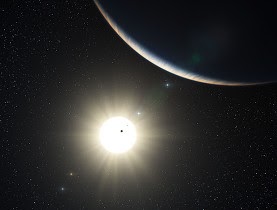
Astronomers have discovered a new solar system that appears to have almost as many planets as our own. They found up to seven planets orbiting a star that is of a similar type to the Sun, including one that is likely to be rocky and less than 1.5 times the size of the Earth.

Reporting his team’s discovery in France today, astronomer Christophe Lovis said: “We have found what is most likely the system with the most planets yet discovered. This remarkable discovery also highlights the fact that we are now entering a new era in exoplanet research – the study of complex planetary systems and not just of individual planets.”

Read more>>

Follow me on Twitter. Please subscribe to our news feed. Get regular updates via Email. Contact us for advertising inquiries.
Read More...

Friday, July 30, 2010

Big Bang Goes Bye Bye?

Technology Review - 7.27.10

A new cosmology successfully explains the accelerating expansion of the universe without dark energy; but only if the universe has no beginning and no end.

As one of the few astrophysical events that most people are familiar with, the Big Bang has a special place in our culture. And while there is scientific consensus that it is the best explanation for the origin of the Universe, the debate is far from closed. However, it's hard to find alternative models of the Universe without a beginning that are genuinely compelling.

That could change now with the fascinating work of Wun-Yi Shu at the National Tsing Hua University in Taiwan. Shu has developed an innovative new description of the Universe in which the roles of time space and mass are related in new kind of relativity.


Read more>>

Follow me on Twitter. Please subscribe to our news feed. Get regular updates via Email. Contact us for advertising inquiries.
Read More...

Thursday, July 01, 2010

First ever direct photo of alien planet!

Space.com - 6.29.10 by Denise Chow

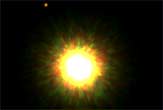
A planet outside of our solar system, said to be the first ever directly photographed by telescopes on Earth, has been officially confirmed to be orbiting a sun-like star, according to follow-up observations.

The alien planet is eight times the mass of Jupiter and orbits at an unusually great distance from its host star — more than 300 times farther from the star than our Earth is from the sun.

Astronomers first discovered the planet in 2008 using visible light observations from telescopes on Earth, making it the first direct photo of an extrasolar world. But at the time there was still the remote chance that it only looked like it was orbiting the star, from the perspective of Earth, due to a lucky alignment of object, star and observer.

Read more>>

Follow me on Twitter. Please subscribe to our news feed. Get regular updates via Email. Contact us for advertising inquiries.
Read More...

Tuesday, May 18, 2010

Mission to Mars: Bring us back some dirt while you're there

AP - 5.18.10 by Alicia Chang

MONROVIA, Calif. — If NASA's exploration of Mars were summed up in a bumper sticker, it would read: "Follow the water."

Well, we've found the water — ice was discovered by the Phoenix lander in 2008. Now what?

It's time to search again for signs of life, scientists say, something they haven't done since 1976. This time, they want to bring Martian rock and soil samples back to Earth. Here, they could be analyzed for fossilized traces of alien bacteria, or chemical or biological clues that could only be explained by something that was alive.

Such a venture as now outlined would be a three-part act, cost as much as $10 billion and take several years to complete. NASA can't afford it on its own so it recently joined the European Space Agency to map out a shared project.

Space policy experts think the timing is right despite the risks and hefty price tag.

"We're about out of things to do on Mars other than a sample return," said George Washington University space scholar John Logsdon. "It is an extremely expensive undertaking, probably the most expensive robotic mission to Mars and clearly the most complex."


Read more>>

Follow me on Twitter. Please subscribe to our news feed. Get regular updates via Email. Contact us for advertising inquiries.
Read More...

Sunday, April 25, 2010

Hawking says, Don't talk to (alien) strangers

TimesOnline - 4.25.10 (by Jonathan Leake)

THE aliens are out there and Earth had better watch out, at least according to Stephen Hawking. He has suggested that extraterrestrials are almost certain to exist — but that instead of seeking them out, humanity should be doing all it that can to avoid any contact.

The suggestions come in a new documentary series in which Hawking, one of the world’s leading scientists, will set out his latest thinking on some of the universe’s greatest mysteries.

Alien life, he will suggest, is almost certain to exist in many other parts of the universe: not just in planets, but perhaps in the centre of stars or even floating in interplanetary space.

Read more>>

Follow me on Twitter. Please subscribe to our news feed. Get regular updates via Email. Contact us for advertising inquiries.
Read More...

Wednesday, April 07, 2010

Wormholes? We may already be in one

Indiana University News Room - 4.5.10

IU theoretical physicist Nikodem Poplawski in research published in "Physics Letters B" uses Euclidean-based mathematical modeling to suggest that all black holes may have wormholes inside which exist universes created at the same time as the black holes.

BLOOMINGTON, Ind. -- Could our universe be located within the interior of a wormhole which itself is part of a black hole that lies within a much larger universe?

Such a scenario in which the universe is born from inside a wormhole (also called an Einstein-Rosen Bridge) is suggested in a paper from Indiana University theoretical physicist Nikodem Poplawski in Physics Letters B. The final version of the paper was available online March 29 and will be published in the journal edition April 12.

Read full report>>

Follow me on Twitter. Please subscribe to our news feed. Get regular updates via Email. Contact us for advertising inquiries.
Read More...

Wednesday, March 31, 2010

Collider creates mini big bangs, and we're all still here

Reuters - 3.30.10 (by Robert Evans)

GENEVA, March 30 (Reuters) - Physicists smashed sub-atomic particles into each other with record energy on Tuesday, creating thousands of mini-Big Bangs like the primeval explosion that gave birth to the universe 13.7 billion years ago.

Scientists and engineers in control rooms across the sprawling European Centre for Nuclear Research (CERN) near Geneva burst into applause as the $9.4 billion project to probe the origins of the cosmos scored its first big success.

"This opens the door to a totally new era of discovery," said CERN's director of research Sergio Bertolucci. "It is a step into the unknown where we will find things we thought were there and perhaps things we didn't know existed."

Read entire story>>

Follow me on Twitter. Please subscribe to our news feed. Get regular updates via Email. Contact us for advertising inquiries.
Read More...

Thursday, March 25, 2010

Seeking to identify dark matter virtually

MSNBC - 3.24.10 (by Clara Moskowitz)

Researchers created a 3D map of dark matter in a large portion of the universe by combining gravitational lensing data from more than half a million galaxies scattered across a range of distances from Earth. The three axes of the box (bottom) correspond to sky position, and distance from Earth, increasing from left to right.

Scientists think they've found a virtual way to hunt for dark matter in the lab by studying real-world materials that may behave similarly to the elusive cosmic stuff.

Dark matter is the name given to the mass that seems to make up much of the universe, but remains frustratingly difficult to detect.

Some theories suggest dark matter is actually composed of tiny particles that don't interact with light or regular matter, except through gravity. One candidate for what dark matter might be made of is a never-before-seen particle called the axion that has a small mass and no charge.

Read entire story>>

Follow me on Twitter. Please subscribe to our news feed. Get regular updates via Email. Contact us for advertising inquiries.
Read More...