Documenting the Coming Singularity

Showing posts with label augmented reality. Show all posts

Sunday, November 03, 2013

Google Glass Will Bring Superhuman Vision

ExtremeTech - 10.24.13 by David Cardinal

Cloud-powered facial recognition is good enough to identify friends and foes alike in near-real-time. Coupled with the massive amount of information available on each of us in the cloud, it is only a small step to the otherworldly experience of never forgetting someone’s name, or knowing when to be on high alert about a person walking towards you.
Stanford professor Marc Levoy, fresh off a two-year leave to work on Google Glass, recently spoke to a packed house at Stanford’s Center for Image Engineering (SCIEN) about the new era of photography that Glass, and other increasingly powerful wearable cameras, have begun to usher in. While many of the new applications have been talked about — like first-person videos and the ability to take pictures without losing eye contact — Levoy explained that those are only the tip of the iceberg. He sees a combination of computational imaging and new-form-factor, camera-equipped devices will allow for a set of what he described as “superhero vision” capabilities.

Rapidly increasing processor power will help fuel this new world of powerful new photographic tools. Levoy, a pioneer in both computer graphics and computational imaging, noted that GPU power is growing by roughly 80% per year, while megapixels are only growing by about 20%. That means more horsepower to process each pixel — with the available cycles increasing each year. Coupled with near-real-time multi-frame image capture, the bounds of traditional photography can even be stretched beyond the borders of a single image.

Read more>>

Please check out our newest site, Cool Mobile Accessories!


Follow me on Twitter. Please subscribe to our news feed. Get regular updates via Email. Contact us for advertising inquiries.
Read More...

Sunday, June 09, 2013

The (Near) Future is Augmented

c|net - 6.7.13 by Dan Farber

"You'll get 20/20, perfectly augmented vision by 2020, with movie-quality special effects blended seamlessly into the world around you,"
Dan Farber/Augmented Reality Expo
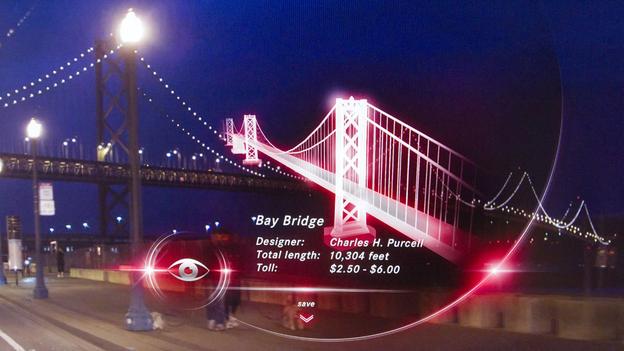
SANTA CLARA, Calif. -- Reality isn't what is used to be. With increasingly powerful technologies, the human universe is being reimagined way beyond Google Glass' photo-tapping and info cards floating in space above your eye. The future is fashionable eyewear, contact lenses or even bionic eyes with immersive 3D displays, conjuring up a digital layer to "augment" reality, enabling entire new classes of applications and user experiences.

Like most technologies that eventually reach a mass market, augmented reality, or AR, has been gestating in university labs, as well as small companies focused on gaming and vertical applications, for nearly half a century. Emerging products like Google Glass and Oculus Rift's 3D virtual reality headset for immersive gaming are drawing attention to what could now be termed the "wearable revolution," but they barely scratch the surface of what's to come.

Read original article>>

Follow me on Twitter. Please subscribe to our news feed. Get regular updates via Email. Contact us for advertising inquiries.
Read More...

Saturday, June 08, 2013

Think Google Glass is Revolutionary? Wait Till the Contacts!

Technology Review - 6.7.13 by Katherine Bourzac

Park wants to make contact lenses that have all the functions of a wearable computer but remain transparent and soft.
For those who find Google Glass indiscreet, electronic contact lenses that outfit the user’s cornea with a display may one day provide an alternative. Built by researchers at several institutions, including two research arms of Samsung, the lenses use new nanomaterials to solve some of the problems that have made contact-lens displays less than practical.

A group led by Jang-Ung Park, a chemical engineer at the Ulsan National Institute of Science and Technology, mounted a light-emitting diode on an off-the-shelf soft contact lens, using a material the researchers developed: a transparent, highly conductive, and stretchy mix of graphene and silver nanowires. The researchers tested these lenses in rabbits—whose eyes are similar in size to humans’—and found no ill effects after five hours. The animals didn’t rub their eyes or grow bloodshot, and the electronics kept working. This work is described online in the journal Nano Letters.

Read original article>>

Follow me on Twitter. Please subscribe to our news feed. Get regular updates via Email. Contact us for advertising inquiries.
Read More...

Wednesday, February 20, 2013

Life Through Google Glass


Follow me on Twitter. Please subscribe to our news feed. Get regular updates via Email. Contact us for advertising inquiries.
Read More...

Wednesday, December 05, 2012

Augmented Reality Coming to Your Windscreen

BBC Future - Dec. 2, 2012 by Jon Stewart

The Mercedes Dice concept allows car passengers to call up information about passing landmarks (Copyright: Daimler AG)
The dangers of talking on a mobile phone or texting whilst driving are well known.  So adding what, on first glance, look like added distractions may not seem like the best idea.

But researchers and car firms are increasingly looking to give drivers enhanced, or augmented reality (AR) that adds extra information ranging from directions to social media feeds to the view through the windscreen. And, perhaps the most unintuitive part of it is that it is designed to make the roads more secure for all of us.

Priceplunge

“The biggest way augmented reality can be useful is in supporting safe driving,” says Professor Anind Dey, of the Human-Computer Interaction (HCI) Institute at Carnegie Mellon University. “The ability to enhance information around us that might otherwise be opaque to us is invaluable.”

AR is usually considered to be a live view of the real world, onto which extra data – usually pulled from the internet - is layered or superimposed. It is similar to the view of the world that Arnold Schwarzenegger had in the Terminator movies.

Read more>>

Follow me on Twitter. Please subscribe to our news feed. Get regular updates via Email. Contact us for advertising inquiries.
Read More...

Saturday, November 24, 2012

Coming Soon - Alternate Reality Gaming

c|net - Nov. 16, 2012 by Casey Newton

Screenshot by Casey Newton/CNET
Last week we began to see the first hints of Google's first foray into so-called "alternate reality gaming," in which cryptic clues are strewn about the on- and offline worlds for the perusal of highly engaged fans. "What is the Niantic Project?" asked a teaser video. As of today, we know the answer: the Niantic Project is a game called Ingress.

As described in a teaser video, Ingress describes a world in which two shadowy sides are vying for dominance: the Enlightened, who are trying to establish portals around the world that will let them control people's minds, and the Resistance, who are trying to stop them.

217424_15% Off Fall Flowers & Gifts

The game takes the form of a free mobile app, now available on the Google Play store for Android devices. It is the second product from Niantic Labs, a startup accelerator within Google. Niantic is run by John Hanke, the former head of product management for Google's "Geo" division, which includes Maps, Earth and Local, among other divisions. Niantic's first project was Field Trip, an Android app for discovering the world around you. Released in September, Field Trip sends notifications to a smartphone whenever a person passes an area of possible interest -- a landmark, a park, a highly rated restaurant. In my use, it's been a fun way of exploring new cities and unfamiliar neighborhoods.

Read more>>

Follow me on Twitter. Please subscribe to our news feed. Get regular updates via Email. Contact us for advertising inquiries.
Read More...

Friday, November 02, 2012

Digital Graffiti Coming to a Wall Near You

NewScientist - October 27, 2012 by Paul Marks

LOOK closely and you can find digital graffiti right under your nose: people have daubed videos, animations and comments over buildings and streets around the world. Soon there could be a new type of tag in our cities - cut-and-pasted people - thanks to a technique for editing augmented reality (AR) videos.

217424_ProFlowers - Send ProFlowers starting at $19.99

Using the AR apps available for smartphones or tablets, anybody can overlay digital text, video and graphics onto the physical world for others to see later. Most major cities are teeming with these digital annotations. You just need to identify a tagged location using your smartphone's map, and watch through the camera using an AR app. Hey presto, a video or animation will then be overlaid on the scene.


Read more>>

Follow me on Twitter. Please subscribe to our news feed. Get regular updates via Email. Contact us for advertising inquiries.
Read More...

Sunday, September 09, 2012

What's Next? HUDSpace, VR and AR

Ramblings in Valve Time - September 7, 2012 by Michael Abrash


If you’re not familiar with VR and AR, VR is the one where you sit down, put on a headset, and find yourself completely immersed in a virtual world like Snow Crash’s Metaverse or Ready Player One’s OASIS (and if you haven’t read Ready Player One, run don’t walk; it’s a great read, especially if you grew up in the 80’s, but even if not – I didn’t, and I still loved it). AR is the one where you put on glasses and walk around, and find that the real world is still there, but modified to a lesser or greater extent, as in Rainbow’s End’s belief circles or the Rivet Couture virtual society of “To Hie from Far Cilenia.”

So with VR, you might take a seat at your computer, put on your VR headset, and find yourself in Middle Earth or a starship or a Team Fortress 2 level. With AR, as you walk down the (real) street wearing your AR glasses you might find that there are (virtual) aliens shooting at you, or that when you encounter (real) members of your Belief Circle they’re wearing (virtual) medieval costumes and glowing faintly, or, to continue the TF2 analogy, that everyone you see is wearing virtual hats.

Read more>>
 
Follow me on Twitter. Please subscribe to our news feed. Get regular updates via Email. Contact us for advertising inquiries.
Read More...

Tuesday, November 22, 2011

Getting texts via your contacts - coming soon?

This will be the coolest thing ever!

MailOnline - 11.22.11 by Fiona Macrae

Imagine catching up with your texts, social networking and perhaps the news  without having to log on to a computer or even glance at  a smartphone.

Messages and images would simply appear in front of your eyes, generated by a computerised contact lens.

Of course, you may not always want to be bothered by such messages if you are doing anything so quaint as – for instance – reading a book or going out walking and enjoying the scenery.

But until now the concept of info-vision – the ability to stream information across a person’s field of vision – had belonged to the realms of science fiction, featuring in films such as the Terminator series or TV shows such as Torchwood.

However, scientists have developed a prototype lens that could one day provide the wearer with all kinds of hands-free information.

Read more>>

Follow me on Twitter. Please subscribe to our news feed. Get regular updates via Email. Contact us for advertising inquiries.
Read More...

Thursday, December 23, 2010

Never have to ask "Have we met before?" again!

Live Science - 12.23.2010 by Michelle Bryner

'Smart' Eyeglasses Fill You In on What You're Looking At

New high-tech glasses track your gaze and display information about what you’re looking at, which could make a simple stroll down the street much more interesting.

Researchers in Finland have made a prototype pair of glasses that attaches to a small handheld computer and retrieves information from a database.

“The glasses recognize people and some objects you see, and try to infer if you would be interested in getting more information about them,” said study co-author Samuel Kaski, director of the Helsinki Institute for Information Technology at Aalto University.


Read more>>

Follow me on Twitter. Please subscribe to our news feed. Get regular updates via Email. Contact us for advertising inquiries.
Read More...

Tuesday, December 21, 2010

Augmented Reality - Big Improvements Coming

NYT - 12.20.2010 by Nick Bilton

Kazuhiro Nogi/Getty Images

Over the weekend I used a new iPhone application, Word Lens, to perform magic tricks for anyone who would watch. Word Lens isn’t really a magic app, but using it was kind of magical for me, almost like seeing Houdini perform in real life. The app is an augmented reality program that can translate text from English to Spanish, and the other way around, instantly through the iPhone’s camera.

It works like this: I hold the iPhone over this blog post, and it instantly translates my words into Spanish. Word Lens is one of the first augmented reality apps that I’ve seen that moves beyond the gimmick stage. It may even be a useful addition to a mobile phone.


Read more>>

Follow me on Twitter. Please subscribe to our news feed. Get regular updates via Email. Contact us for advertising inquiries.
Read More...

Monday, May 24, 2010

Augmented reality navigation (with video)!

Wikitude - 5.20.10

Wikitude Drive, the first mobile Augmented Reality (AR) satellite navigation system with global coverage, launches for test drivers.

Salzburg, May 20, 2010. Wikitude Drive, the Grand Prize Winner of the Global Navteq LBS Challenge 2010 at Mobile World Congress last February in Barcelona, transforms your Android smartphone into a mobile navigation system looking a bit like something out of a science fiction movie…


Driving directions not only appear on screen, they are overlaid on the live video stream of the very street you are driving on. As a result, you are seeing the real world and real road in front of you, while being directed by a digital route on top of it.

Read more>>

Follow me on Twitter. Please subscribe to our news feed. Get regular updates via Email. Contact us for advertising inquiries.
Read More...

Wednesday, May 05, 2010

Chalmers on Simulation and Singularity

David Chalmers at Singularity Summit 2009 -- Simulation and the Singularity from Singularity Institute on Vimeo.


Follow me on Twitter. Please subscribe to our news feed. Get regular updates via Email. Contact us for advertising inquiries.
Read More...

Thursday, April 29, 2010

Augmented Reality Flooring - putting the beach in your living room

Technology Review - 4.28.10 (by Kristina Grifantini)

Augmented Steps This "haptic" floor can mimic the look and feel of sand.
Credit: Yon Visell


Researchers at McGill University in Montreal, Canada have developed floor tiles that can simulate the look, sound and feel of snow, grass or pebbles underfoot. Such a tool could perhaps be used for augmented reality applications, tele-presence, training, rehabilitation or even as virtual foot controllers.

The modular "haptic" floor tiling system is made up of a deformable plate suspended on a platform. Between the plate and platform are sensors that detect forces from the user's foot. And the plate can give off vibrations that mimic the feeling of stepping on different materials. A top-down projection and speakers add visual and audio feedback.


Read more>>

Follow me on Twitter. Please subscribe to our news feed. Get regular updates via Email. Contact us for advertising inquiries.
Read More...

Thursday, March 18, 2010

Augmented reality coming to your car's windshield

Technology Review - 3.17.10 (by Kristina Grifantini)

A new "enhanced vision system" from General Motors could help drivers by highlighting landmarks, obstacles and road edges on the windshield in real-time. Such a system can point out to drivers potential hazards, such as a running animal, even in foggy or dark conditions, GM says.

Head-up displays (HUDs) are already used to project some information--like a car's speed or directions--directly in front of the driver, through the windshield, or even through a side view mirror. These sorts of displays have started appearing in high-end cars, and typically work by projecting light to create an image on part of the windshield.

Read entire story>>

Follow me on Twitter. Please subscribe to our news feed. Get regular updates via Email. Contact us for advertising inquiries.
Read More...

Tuesday, February 23, 2010

Augmented Identity - I know who you are (if not what you did!)

Technology Review - 2.23.10 (by Erika Jonietz)


An application that lets users point a smart phone at a stranger and immediately learn about them premiered last Tuesday at the Mobile World Congress in Barcelona, Spain. Developed by The Astonishing Tribe (TAT), a Swedish mobile software and design firm, the prototype software combines computer vision, cloud computing, facial recognition, social networking, and augmented reality.

"It's taking social networking to the next level," says Dan Gärdenfors, head of user experience research at TAT. "We thought the idea of bridging the way people used to meet, in the real world, and the new Internet-based ways of congregating would be really interesting."

Read entire story>>

Follow me on Twitter. Please subscribe to our news feed. Get regular updates via Email. Contact us for advertising inquiries.
Read More...

Saturday, November 14, 2009

Augmented Reality Contacts - very sweet!

NewScientist - 11.12.2009 by Vijaysree Venkatraman

A contact lens that harvests radio waves to power an LED is paving the way for a new kind of display. The lens is a prototype of a device that could display information beamed from a mobile device.

Realising that display size is increasingly a constraint in mobile devices, Babak Parviz at the University of Washington, in Seattle, hit on the idea of projecting images into the eye from a contact lens.

One of the limitations of current head-up displays is their limited field of view. A contact lens display can have a much wider field of view. "Our hope is to create images that effectively float in front of the user perhaps 50 cm to 1 m away," says Parviz.

Read entire story>>

Follow me on Twitter. Technological Singularity and Futurism is updated often; the easiest way to get your regular dose is by subscribing to our news feed. Stay on top of all our updates by subscribing now via RSS or Email.
Read More...

Friday, October 16, 2009

Heads-Up goes Holo

Technology Review - 10.19.2009 (by Duncan Graham-Rowe)

A new projection technology could see in-vehicle displays pop up in wing mirrors.

Wing vision: Holographic projection creates a head-up display in a vehicle's wing mirror.

In the last few years, head-up displays (HUDs), which project information onto the driver's view of the road, have started appearing in a few high-end cars. But a more compact kind of projection device, small enough to fit inside a rearview mirror, could see this kind of display more widely deployed.

A head-up display overlays information on a normal view of the road. For example, symbols can be used to show the car's current speed or the distance to the vehicle ahead without the driver having to look away from the road.

Read entire story>>

Follow me on Twitter. Technological Singularity and Futurism is updated often; the easiest way to get your regular dose is by subscribing to our news feed. Stay on top of all our updates by subscribing now via RSS or Email.
Read More...

Monday, October 05, 2009

Augment your reality with Wikipedia overlays

New York Times - 10/2/09 (by Marshall Kirkpatrick)

What is that mountain you're driving past? Just point your iPhone at it and you can read its Wikipedia entry. Science fiction? Not anymore. Two new apps for viewing Wikipedia entries about physical locations you look at through your iPhone camera are now available in the iTunes store.

Wikitude and Cyclopedia are the names of the apps and both require the new iPhone 3GS. That's because the 3GS is the first iPhone with an internal compass - Augmented Reality (AR) apps use your phone's GPS to know where you are and the compass to know which direction you're looking at. Then these two apps can tell you what you're looking at that's written up in Wikipedia. Here's how the two different apps compare.

Read entire story>>

Follow me on Twitter. Technological Singularity and Futurism is updated often; the easiest way to get your regular dose is by subscribing to our news feed. Stay on top of all our updates by subscribing now via RSS or Email.
Read More...

Friday, September 25, 2009

Augmented reality in a contact lens - the future approaches

IEEE Spectrum - 9/09 (by Babak A. Parviz)

A new generation of contact lenses built with very small circuits and LEDs promises bionic eyesight.

The human eye is a perceptual powerhouse. It can see millions of colors, adjust easily to shifting light conditions, and transmit information to the brain at a rate exceeding that of a high-speed Internet connection.

But why stop there?

In the Terminator movies, Arnold Schwarzenegger’s character sees the world with data superimposed on his visual field—virtual captions that enhance the cyborg’s scan of a scene. In stories by the science fiction author Vernor Vinge, characters rely on electronic contact lenses, rather than smartphones or brain implants, for seamless access to information that appears right before their eyes.

These visions (if I may) might seem far-fetched, but a contact lens with simple built-in electronics is already within reach; in fact, my students and I are already producing such devices in small numbers in my laboratory at the University of Washington, in Seattle [see sidebar, "A Twinkle in the Eye"]. These lenses don’t give us the vision of an eagle or the benefit of running subtitles on our surroundings yet. But we have built a lens with one LED, which we’ve powered wirelessly with RF. What we’ve done so far barely hints at what will soon be possible with this technology.

Read entire story>>

Follow me on Twitter. Technological Singularity and Futurism is updated often; the easiest way to get your regular dose is by subscribing to our news feed. Stay on top of all our updates by subscribing now via RSS or Email.
Read More...