Sounds like something from Alice in Wonderland, but it's true.
Ryan F. Mandelbaum on Gizmodo
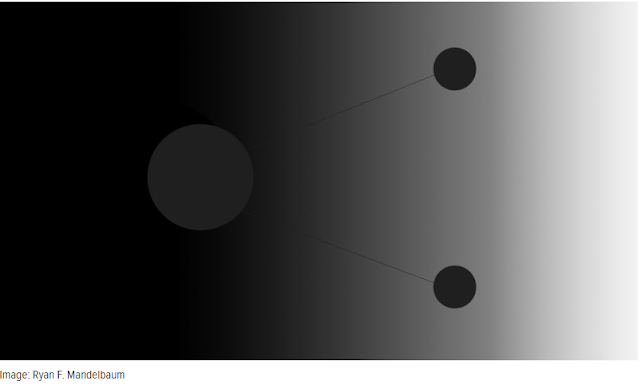
It appears that the Universe is full of dark matter—around six times more of it than there is regular matter. It has obvious visible effects, like the way it bends light from distant galaxies. Despite dedicated searches, no signs of a dark matter particle explaining these effects have turned up.
Perhaps instead physicists will be able to find some dark force, a portal into the dark world. Such a “dark photon” would be dark matter’s equivalent of a photon, the way that dark matter particles interact with one another. Scientists are searching for such a particle. It hasn’t turned up yet, based on new results from the Large Hadron Collider in Geneva, Switzerland. But the search isn’t over—and a lot of physicists are really excited about it.
“LHCb had to work really hard to get to this mass range,” Caterina Doglioni, a researcher at Lund University who was not involved in the study, told Gizmodo. “The way they did it is quite cool. They reinvented the data taking of LHC experiments”
Physicists have been using plenty of methods such as big vats of liquid xenon to try and find dark matter particles directly, and still have no leads. Dark photons would take dark matter’s story deeper, and imply that there’s a dark universe governed by dark forces.
Read more...
Read More...
Ryan F. Mandelbaum on Gizmodo

It appears that the Universe is full of dark matter—around six times more of it than there is regular matter. It has obvious visible effects, like the way it bends light from distant galaxies. Despite dedicated searches, no signs of a dark matter particle explaining these effects have turned up.
Perhaps instead physicists will be able to find some dark force, a portal into the dark world. Such a “dark photon” would be dark matter’s equivalent of a photon, the way that dark matter particles interact with one another. Scientists are searching for such a particle. It hasn’t turned up yet, based on new results from the Large Hadron Collider in Geneva, Switzerland. But the search isn’t over—and a lot of physicists are really excited about it.
“LHCb had to work really hard to get to this mass range,” Caterina Doglioni, a researcher at Lund University who was not involved in the study, told Gizmodo. “The way they did it is quite cool. They reinvented the data taking of LHC experiments”
Physicists have been using plenty of methods such as big vats of liquid xenon to try and find dark matter particles directly, and still have no leads. Dark photons would take dark matter’s story deeper, and imply that there’s a dark universe governed by dark forces.
Read more...
Give your phone a refreshing new look! Grab a beautiful cell phone or tablet case from Cool Mobile Accessories, offering cases and accessories for your favorite devices!
Breathe right, and say goodbye to allergens! Get the exact size air-condition or furnace filter you need, cut to order, shipped to your door! Only from: Perfectly Pure Air Filters


 Posts
Posts


